London Ontario Road Construction 2026: What Homebuyers & Sellers Need to Know | Sean Cuddy Realtor
Tuesday, May 12, 2026
London Ontario Real Estate · May 2026
Will London's Roads Ever Be Finished?
A Realtor's Take on the Endless Construction
If you live in London, Ontario, you already know the drill. You leave the house with plenty of time to make it to your appointment — and then you hit the orange cones on Oxford Street. Or the lane closure on Highbury. Or the detour signs around Wellington Road. By the time you arrive, you're five minutes late, mildly frustrated, and wondering — as many Londoners are — will this city ever stop being a construction zone?
As a realtor who drives to client meetings, open houses, and property showings across London every single day, I feel this more than most. And I want to give you an honest, informed look at what is actually happening out there, why it feels never-ending, what the city's Bus Rapid Transit (BRT) project promises — and what all of this means if you're thinking about buying or selling a home in London right now.
One of the Biggest Construction Seasons in London's History
Let's start with the numbers, because they are genuinely staggering. The City of London's 2026 Renew London program represents approximately $385 million in construction work — described by the city itself as one of the largest construction seasons in London's history. That includes $285 million in new capital projects and another $100 million in work carried over from 2025.
Over 100 lane kilometres of roadwork are underway, along with improvements to 20 intersections and more than 30 kilometres of underground infrastructure — water mains, storm sewers, and sanitary systems that most of us never see but absolutely depend on.
2026 Renew London — By the Numbers
- $385M total program value
- 100+ lane km of road work
- 20 intersections being upgraded
- 30+ km of underground infrastructure
- Top projects: Highbury Ave South, Western Rd / Philip Aziz Ave, Wellington Gateway Phase 2, East London Link
Among the headline projects for 2026: Highbury Avenue South is being repaired and upgraded from the Thames River all the way to Highway 401, including bridge work at Commissioners Road and Bradley Avenue. Western Road near Western University is getting intersection and road upgrades. And the Bradley Avenue extension between Wharncliffe and White Oak Road is now underway — creating a four-lane complete street with sidewalks, bike lanes, lighting, and landscaping.
Mayor Josh Morgan put it plainly: "London has experienced some of the fastest population growth in the country over recent years, so the scale of infrastructure investment we are undertaking is essential to meet our current and future needs."
Why Does It Always Seem to Be the Same Roads?
Here's the frustrating reality: London isn't just fixing roads — it's rebuilding the entire ecosystem beneath them at the same time. Much of the construction happening right now involves underground water, sewer, and storm systems that are decades old. You can't repave a road properly if the pipes underneath are failing — so everything has to come up together.
The city uses a coordinated approach called Infrastructure Renewal Projects (IRPs), where road, sewer, watermain, and utility work are all completed simultaneously in the same corridor. The goal is smart: tear the road up once, fix everything, put it back together properly — rather than repaving, only to dig it up again two years later for sewer work. That logic makes sense on paper. Living through it is another matter entirely.
"It's not just road repair — it's all of the services underneath: sewer, water, and all of that. With climate change, the weather is going to be more unpredictable, more of this freezing and thawing, which is really hard on our roads."
— Infrastructure expert, as reported by Global News
And here's the harder truth: London deferred infrastructure maintenance for years. Council after council was reluctant to fund the repair gap — and now we're all paying for it, in tax dollars and commute time, simultaneously. The bill came due. We're paying it now. All at once.
The Real-World Impact: Getting Around London in 2026
For anyone driving professionally — realtors, contractors, salespeople, care workers, delivery drivers — this is not an abstract inconvenience. It is a daily operational challenge. Routes that used to take 12 minutes now take 25. A showing on the east end followed by a meeting downtown followed by a listing appointment in the southwest requires genuine navigation strategy, not just a glance at Google Maps.
The city is actively warning residents that lane restrictions, detours, and periodic closures are expected across major routes throughout the spring and summer of 2026 as construction ramps up. Key arteries that are affected include Highbury Avenue, Western Road, Wellington Road / Street, Oxford Street, Dundas Street, and Bradley Avenue. Clark's Bridge on Wellington Road is also mid-reconstruction, causing ongoing disruptions to one of London's most-used north-south corridors.
My honest advice for navigating London right now: buffer every drive by at least 15 minutes. Keep Waze or Google Maps running and set to avoid closures. Know your alternate routes — if Wellington is jammed, know that Clarke Road or Wharncliffe may get you there. And if you're searching for a home or selling one, partner with a realtor who knows this city's neighbourhoods and how to actually move through them.
Bus Rapid Transit: London's $454 Million Bet on the Future
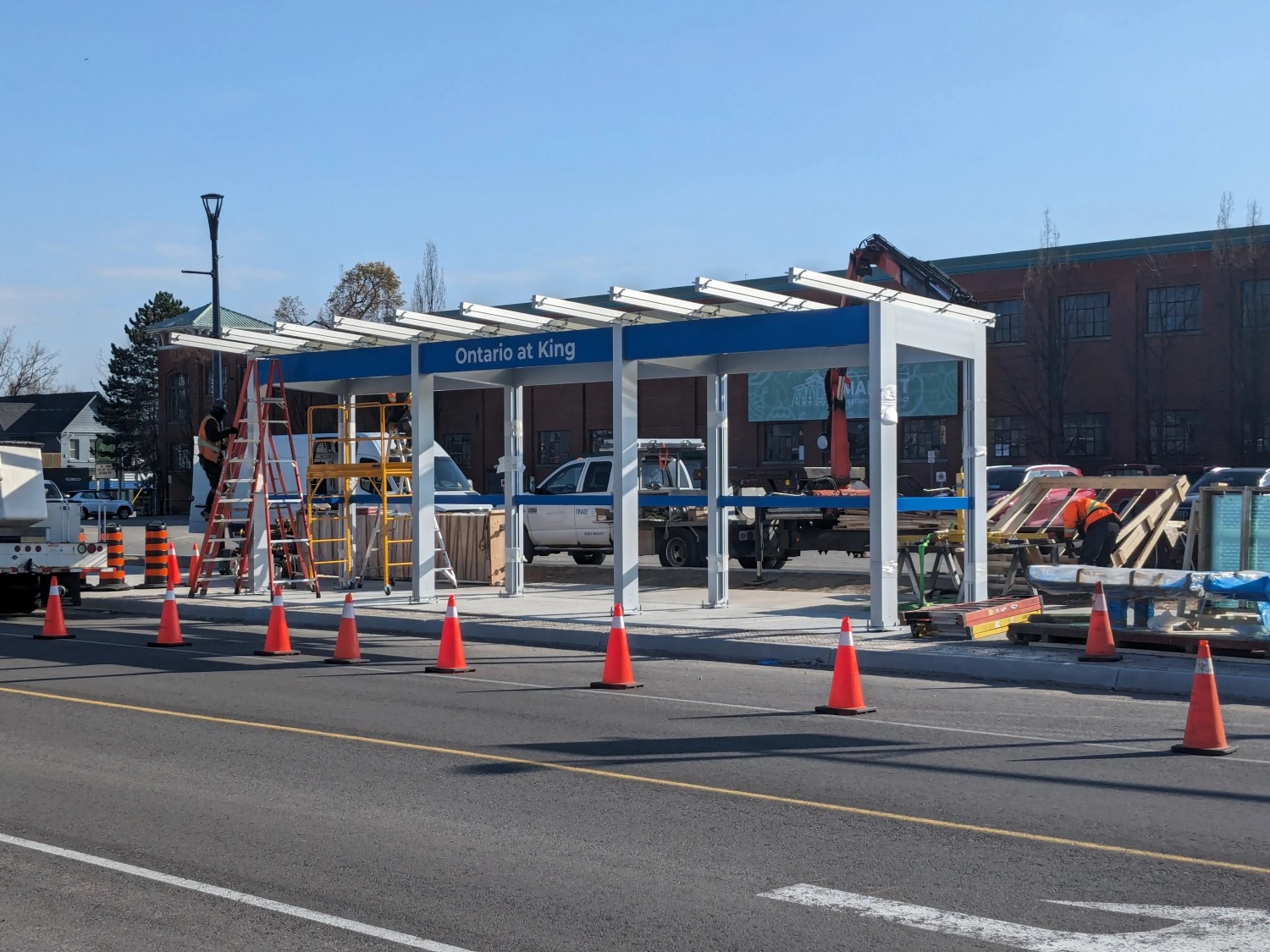
Running through all of this construction — quite literally, down the middle of many of our major streets — is the most ambitious transit project London has ever undertaken: the Bus Rapid Transit (BRT) network, formerly known as Shift.
The BRT system consists of two corridors converging at a central downtown hub, with a total approved budget of $454 million and contributions from all three levels of government. The network will stretch 15.8 kilometres across the city, with 23 stations spaced roughly 600 to 800 metres apart.
Where does it stand today? The Downtown Loop is already fully open, with dedicated red bus lanes and transit signal priority in use. The East London Link — running from downtown along Dundas Street east to Fanshawe College — is scheduled for completion in 2026, with service expected to launch in mid-2027. The Wellington Gateway, running south from downtown along Wellington Road, is expected to be complete by 2027, with operations beginning in summer 2028.
BRT Fast Facts — London Ontario
- Total cost: $454 million (federal, provincial & municipal)
- Length: 15.8 km, 23 stations
- East London Link: service target mid-2027
- Wellington Gateway: service target summer 2028
- Frequency: buses every 5–10 minutes on BRT corridors
- Downtown Loop: already open and in use
Will BRT Actually Unclog London's Roads?
This is the million-dollar question — or, more accurately, the $454 million question. The honest answer is: yes, eventually — but not immediately, and not for everyone.
The theory is sound. BRT removes buses from general traffic lanes and gives them their own dedicated space, which benefits both transit riders and drivers simultaneously. When buses aren't blocking turning lanes or sitting in traffic, general vehicle flow improves. And when the BRT system is fast, frequent, and reliable enough to attract riders, more people leave their cars at home — which means fewer vehicles competing for road space.
London's BRT was designed with a specific mode share target in mind: increasing the percentage of trips made by walking, cycling, or transit from 12.5% to 20% by 2030. When the system was first conceived, that goal seemed ambitious. Remarkably, the city's 2025 Mobility Master Plan noted that London has already achieved that target ahead of schedule — which is why the plan has now identified additional future BRT corridors, including routes toward Masonville, west along Oxford, and north along Wonderland Road.
"It's going to mean shorter commutes and better and easier commutes for everybody — whether you're driving, or walking, or taking the bus."
— City of London BRT Project Director, CBC News
The system also brings smart traffic signal technology that synchronizes signals around BRT corridors, acting as what one planner described as "a central eye in the sky" to spot and respond to traffic patterns. That kind of integrated signal management benefits all road users, not just transit riders.
But There Are Real Concerns Worth Acknowledging
Not everything about BRT is a guaranteed win for drivers, and it would be dishonest to pretend otherwise. Dedicated centre-running bus lanes effectively reduce the number of general traffic lanes on corridors like Wellington Road and Dundas Street. During the transition period — which London is squarely in right now — that compression of road capacity is contributing to the congestion many of us experience daily.
There are also legitimate readiness concerns. A recent report prepared by Stantec for the City highlighted that London Transit does not yet have all-door boarding capability or modern fare payment technology in place ahead of the BRT launch. Without these features, buses may still experience slow station dwell times that undermine the system's speed advantage. The city and London Transit Commission have acknowledged these gaps and have committed to addressing them before service begins.
The bottom line: BRT is the right long-term investment for a city growing as fast as London. But the short-term pain is real, it is widespread, and it will continue for at least another two to three years before the full benefits arrive.
What Does All This Mean for London Real Estate?
Here's where I put on my realtor hat and give you something practical to take away from all of this.
Construction-adjacent properties are being mispriced — in both directions. Some buyers are steering clear of neighbourhoods near active construction corridors, creating opportunity for those willing to look past temporary disruption. When Highbury Avenue is fully rehabilitated, when Wellington Gateway opens for BRT service, when Bradley Avenue becomes a proper complete street — properties near those corridors will look very different from how they look today.
BRT access will become a selling feature. In cities where rapid transit systems have launched, walkable access to transit corridors has demonstrably supported property values. London is heading in that direction. Neighbourhoods along Wellington Road South, Oxford Street East, and the downtown core are positioning themselves as transit-accessible in a way that simply wasn't possible five years ago.
Infrastructure investment is a signal of confidence. A city spending $385 million in a single construction season — backed by federal and provincial partnerships — is not a city in decline. It is a city making a generational bet on its own future. As painful as it is to sit through construction, it is a sign that London is growing, investing, and building for the long term. For homeowners, that is ultimately good news.
Navigating London — On the Road & In the Market
Whether you're buying your first home, selling and upsizing, or just trying to figure out which neighbourhoods make the most sense in a city that's changing this fast — I'm here to help. I drive these streets every day. I know this city.
Visit buyingsellinglondon.caSean Cuddy - London Ontario Realtor
The Realty Firm Inc.
Cell: 548-888-7326
email: Sean@SeanCuddy.com
Helping Londoners buy and sell homes with local knowledge, honest advice, and zero runaround. buyingsellinglondon.ca